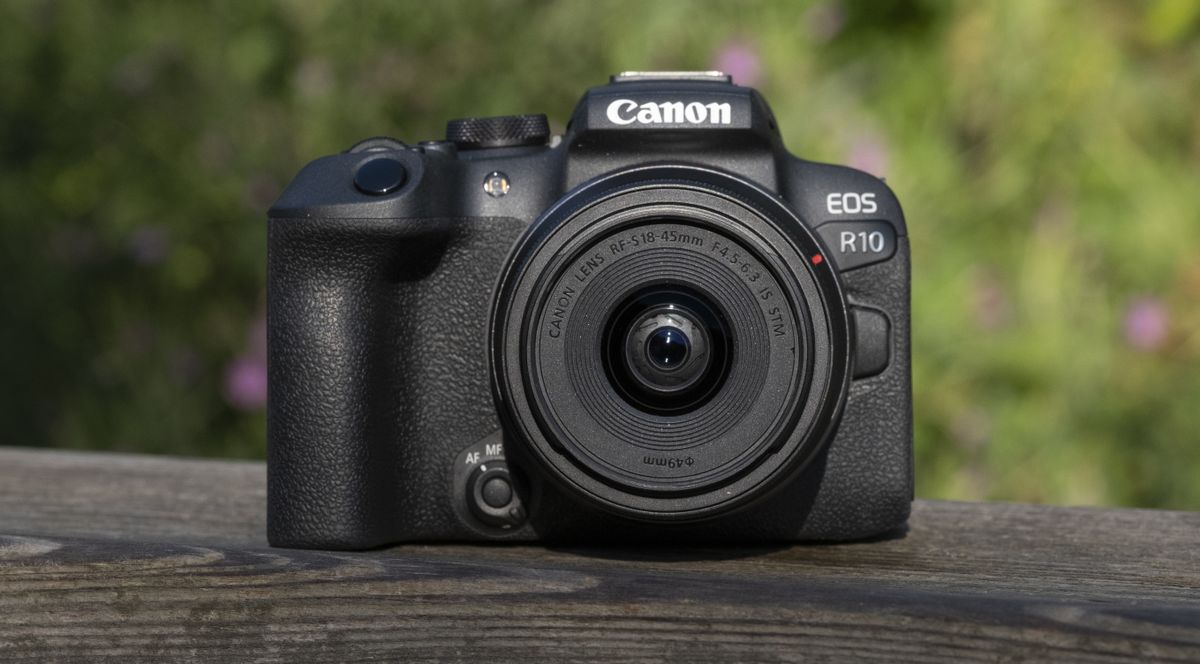
The Canon EOS R10 is an entry-level APS-C mirrorless camera. In Canon’s lineup, it sits above the more explicitly beginner-oriented Canon EOS R50 and Canon EOS R100 but camera review comparison below the more advanced Canon EOS R7. It represents a compelling middle ground, with an advanced Dual Pixel CMOS II autofocus system, compact and user-friendly design, and many automatic shooting modes, along with enough physical controls to keep more advanced photographers happy.
The Canon R10 is good for travel photography. Even with its relatively large handgrip, it’s small and light enough to be easily carried around in a bag or on a sling for hours. The overall image quality is also very good, and the camera’s autofocus system is fast and accurate enough to lock onto moving subjects. Its fully-articulated screen also makes it easier to snap pictures from unusual angles. Unfortunately, while it has a longer battery life than its M-mount predecessors, it’s still best to bring another pack or two for longer days.
Pros
Lightweight, well-built body.
Good image quality.
Reliable autofocus system.
Comfortable to shoot with.
Cons
Unspectacular battery life.
Differences Between Sizes And Variants
The Canon R10 is only available in a Black colorway. You can see our unit’s label here. You can buy the R10 camera body on its own or in a bundle with either the RF-S 18-45mm f/4.5-6.3 IS STM kit lens or the Canon RF-S 18-150mm f/3.5-6.3 IS STM kit lens.
Let us know if you encounter any other variants, and we’ll update our review.
Compared To Other Cameras
The Canon R10 is a mid-range mirrorless camera that offers quite a bit of bang for the buck, with a mix of features and ease of use that makes it a good fit for both beginner photographers and more experienced users who are looking to downsize their kit or are searching for a portable backup body. Compared to the cheaper Canon EOS R50, it boasts a more advanced set of physical controls, faster shooting speeds, and the ability to shoot 4k video at 60 fps. That said, you do lose out on the higher resolution sensor, a larger-capacity battery, in-body stabilization, and a weather-sealed body that comes with the pricier Canon EOS R7.
If you’re looking for an alternative, look at our recommendations for the best cameras for beginners, the best mirrorless cameras, or the best digital cameras more broadly.
The Canon EOS R10 is better than the Canon EOS R50 in most ways, which isn’t surprising considering the R10 occupies a higher spot in the model hierarchy. The two cameras share the same imaging sensor, but the R10 has a more robust set of physical controls, has faster continuous shooting speeds, and can record 4k video at up to 60 fps, though with a severe crop. While the R50 is a little more compact, the R10’s larger handgrip also makes it more comfortable for a wider range of people.
The Canon EOS R7 is a more capable camera than the Canon EOS R10. The R7 has an in-body stabilization system and a higher-resolution 32.5 MP sensor and uses a higher-capacity battery that yields a longer battery life. Unlike the R10, it also supports C-Log 3 and can record oversampled 4k video at up to 30 fps or uncropped regular 4k video at 60 fps. While the R10 is noticeably smaller and lighter, the R7’s body also has the advantage of being weather-sealed, and it features both twin UHS-II card slots and a headphone jack, though there’s no pop-up flash like there is on the R10.
The Canon EOS R10 and the Canon EOS R8 are both good cameras that use different-sized sensors. The R10 will offer a bit more value for its price for most people, with faster burst shooting and better battery life, along with very respectable video features. On the other hand, if you need full-frame image quality in a portable camera body, the R8 is the way to go.
 Site Title
Leave a comment